This past quarter, my Algebra 2 class has been testing out something different from the regular math homework on Wednesday. Usually, every classroom assigns less homework in general on Wednesdays, which for math class just means fewer problems. I thought that break made Wednesday a good opportunity to try something new—assignments I have been calling “proof papers.”
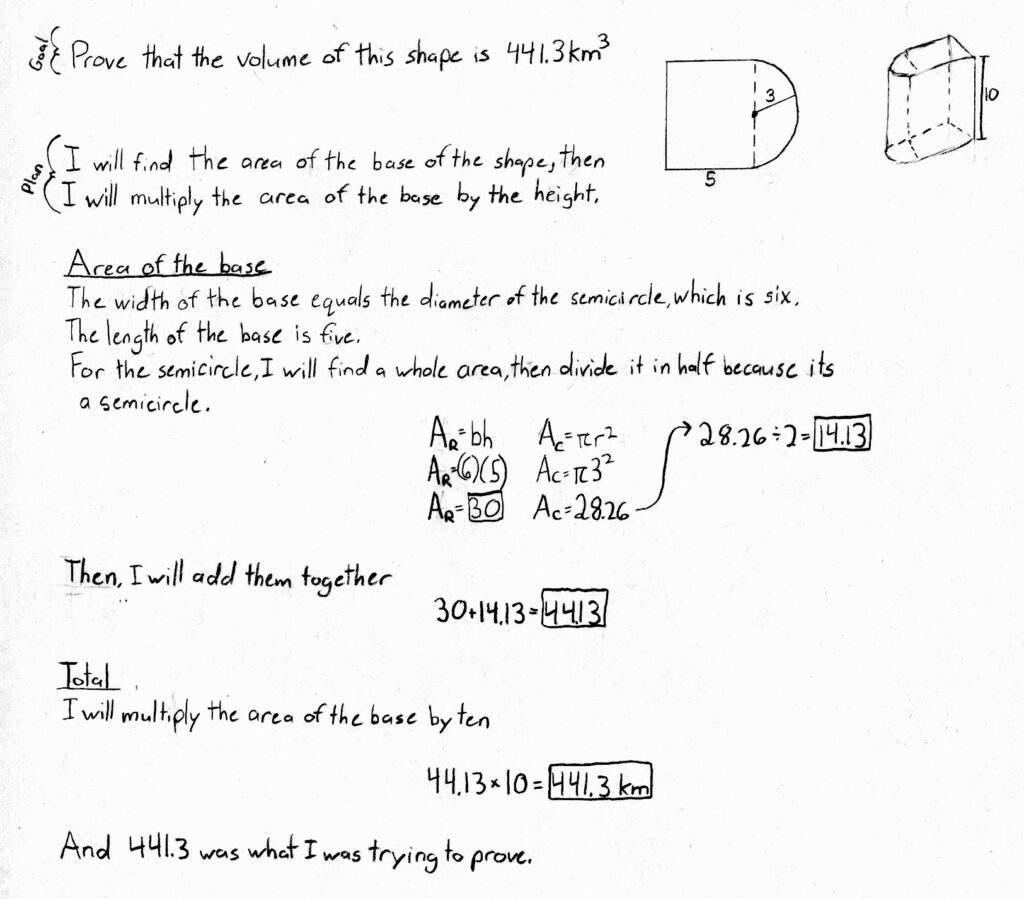
Proof papers work like this: each student receives a blank, white sheet of paper and one single problem to solve. The goal, however, isn’t to find the answer to the problem; the answer is actually given to them at the beginning. The goal is rather for the student to prove that the given answer is true. For example, rather than asking the student, “What is the surface area of this cylinder?” instead I tell the student, “Prove that the volume of this cylinder is 109.9 square feet.” The student then follows a certain pattern of proving the answer, using mostly words, with a few necessary formulas and calculations. The end result is a nice-looking argument, with the student explaining the reasoning behind each step. I’ve included a couple of simple examples of proof papers that you can see for yourself.
What strange experiment is Mr. Hahn conducting on the Algebra 2 students? Really, it’s not an experiment, but an attempt to put into practice a couple classical mathematical ideas that seem to be lacking in modern math textbooks. The first classical math idea I want students to learn is the idea of proof. Proofs have always been to math as orations are to speech. A proof is a combination of all the little truths, tools, and tricks you’ve learned in math which culminates in a grand, new truth (and a satisfying, smart-looking paper!). That’s much like an oration demonstrates mastery over many parts of language to accomplish a certain purpose for the listener. The neat thing about a proof is that it’s just as much about the destination as it is about the journey, and that journey is easy to miss when you’re not forced to sit down, take your time, and write out your thoughts. Doing math without that in-between material is like giving a speech but skipping straight from the opening to the closing. A good mathematician cares about the path from start to finish. In our proof papers, the goal is to help students see that path more clearly by using a structure similar to how Euclid the Greek geometer wrote his proofs (who also began his proofs by stating the answer he was trying to prove).
The second of these ideas is that working in language is the primary way humans do math. Using words more than symbols is how mathematical thinking had been done in the West for a long time. Read any mathematical book from our good friends the Greeks, and you’ll find paragraph upon paragraph walking you through mathematical ideas—with some symbols, but with a lot more words. Despite our very symbolic way of doing math today, I have found that our math minds ultimately still work the same wordy way. Sure, someone can accurately work through an algebra problem without using words; but if asked to explain what the problem means, it’s extremely difficult without just talking about symbols all over again. That struggle betrays the fact that we know about the process we’re using, but not about the underlying truth. What I intend with proof papers is to get students thinking about math with words again, and therefore help them actually understand the truths they’re dealing with. We use words for so many other subjects in school; why not math too?
I’m looking forward to seeing more good proofs from this class; my hope is that the students learn to understand more clearly the beautiful truths God has put in the world for us to discover.
In Christ,
Mr. Hahn
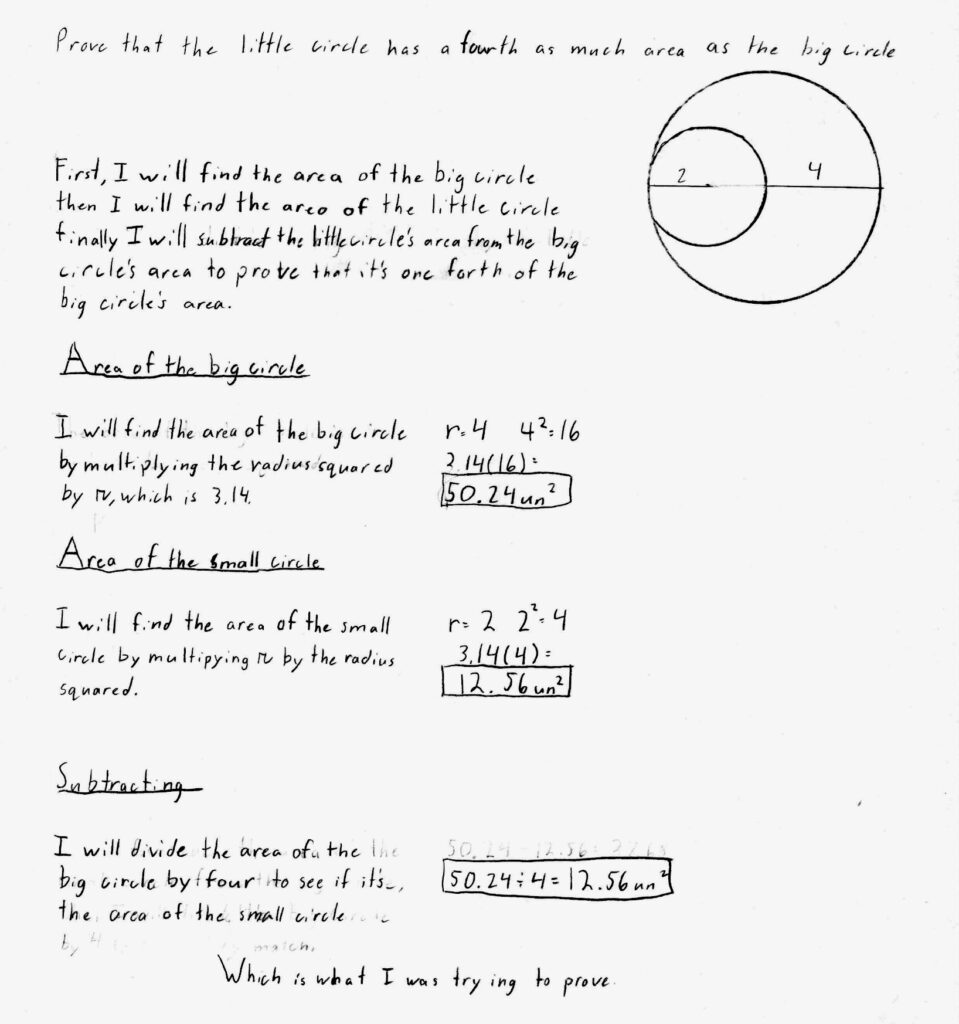
Image: A papyrus fragment of Euclid’s Elements Book II, Proposition 5 dated 3rd-4th century AD; courtesy of University of Pennsylvania Museum of Archaeology and Anthropology